
Architecting Resilient Enterprise Cloud Solutions on Azure
A deep dive into building mission-critical, secure, and globally distributed cloud platforms using Microsoft Azure. From zero-trust identity with Entra ID to serverless compute, geo-distributed databases, and edge routing.
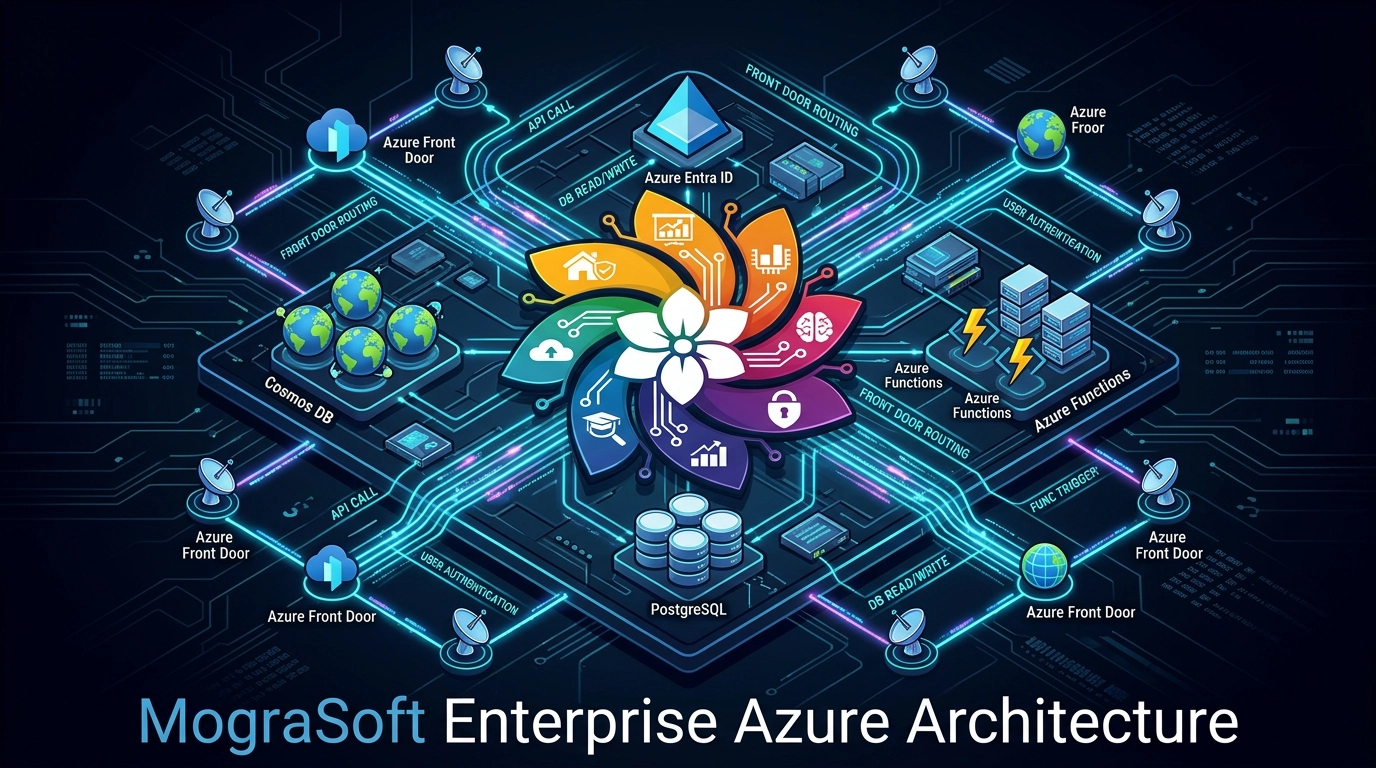 Click to Expand
Architecture Vision
Modern cloud systems require a balance of high availability, global scalability, robust security controls, and cost efficiency. Building on Microsoft Azure enables enterprise workloads to scale seamlessly while enforcing granular identity policies and maintaining low-latency database access across geographic regions.
1. Microsoft Entra ID & Zero Trust Foundation
Identity is the primary security boundary in cloud applications. Implementing Microsoft Entra ID (formerly Azure Active Directory) establishes a unified Zero Trust model across microservices, developers, and administrators.
Key Implementation Pillars:
- Managed Identities for Azure Resources: Eliminate embedded credentials in code by utilizing System-Assigned and User-Assigned Managed Identities for seamless authentication to Azure Key Vault, SQL databases, and Blob Storage.
- Entra Workload ID: Enables containerized services running in Azure Kubernetes Service (AKS) or Azure Container Apps to securely access Azure resources without secret management.
- Conditional Access & PIM: Enforce Privileged Identity Management (PIM) with Just-In-Time (JIT) access for administrative roles and strict MFA policies based on device compliance and threat signals.
"Never trust, always verify. Leveraging Entra ID Managed Identities ensures secret-less application runtime environments across the entire SDLC."
2. Azure Blob Storage & Data Lake Storage Gen2
Azure Blob Storage delivers massively scalable, secure object storage optimized for unstructured data, logs, media, and enterprise data analytics via Azure Data Lake Storage (ADLS) Gen2 hierarchical namespaces.
Lifecycle Management
Automatically transition blobs between Hot, Cool, Cold, and Archive access tiers based on access patterns to optimize operational storage costs.
Network Isolation & Security
Block public internet access completely using Azure Private Endpoints within Virtual Networks (VNet) and enforce Customer-Managed Keys (CMK) encryption.
3. Azure Cosmos DB: Global Multi-Region NoSQL
For distributed applications demanding single-digit millisecond response times globally, Azure Cosmos DB provides multi-region write capability, guaranteed 99.999% availability, and configurable consistency levels.
| Consistency Model | Latency / Throughput | Best Use Case |
|---|---|---|
| Strong | Higher Latency / Strict Order | Financial Transactions, Inventory Lock |
| Session (Default) | Low Latency / Read-Your-Writes | User Profiles, Social Feeds, E-commerce Carts |
| Eventual | Lowest Latency / Highest Scale | Telemetry, Logging, Analytics Aggregations |
4. Event-Driven Compute with Azure Functions
Serverless computing with Azure Functions decouples workload processing into discrete, event-driven microservices that scale automatically from zero to thousands of instances in response to HTTP requests, Service Bus messages, or database change feeds.
Enterprise Serverless Patterns:
- Durable Functions: Statefully coordinate complex orchestrations, fan-out/fan-in patterns, and long-running human workflows using C# or TypeScript.
- VNet Integration: Securely place serverless functions inside isolated Azure Virtual Networks to communicate privately with backend databases.
- Cosmos DB Trigger: Process change-feed records in real time to trigger background processing or downstream data synchronization.
5. Edge Delivery: Azure Front Door & Application Gateway
Combining **Azure Front Door** at the global edge with Azure Application Gateway at the regional VNet layer creates a multi-layered defense-in-depth routing topology.
Azure Front Door
Global Anycast network providing Content Delivery Network (CDN) acceleration, global HTTP load balancing, SSL offloading, and Web Application Firewall (WAF) protection at Microsoft's edge locations.
Azure Application Gateway
Regional Layer 7 load balancer handling URL path-based routing, TLS termination inside the Virtual Network, and private origin protection before forwarding traffic to backend APIs.
6. Azure Database for PostgreSQL - Flexible Server
When relational consistency and open-source standards are required, Azure Database for PostgreSQL - Flexible Server provides a fully managed database service with fine-grained control over compute scaling and database configuration.
Key Capabilities:
- Zone-Redundant High Availability: Automatic failover across availability zones with zero data loss (RPO=0).
- Built-in PgBouncer: Integrated connection pooling to handle high-concurrency serverless function execution.
- Vector Search with pgvector: Enable AI-driven Retrieval-Augmented Generation (RAG) applications directly inside PostgreSQL.